|
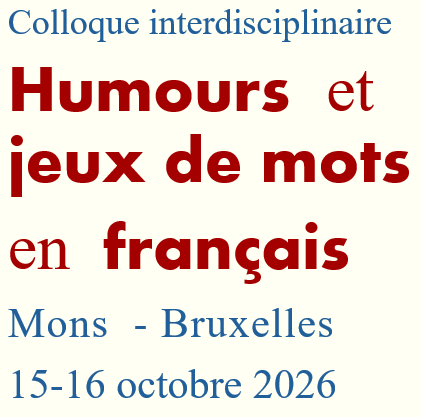
15-16 Oct 2026 Mons et Bruxelles (Belgium)
|
|
humor and wordplay in French Humour and wordplay in French
Between literary, discursive, interlinguistic, translation studies and didactic analyses
Interdisciplinary conference, 15-16 October 2026, University of Mons (French and Francophone Studies Department, SÉf&f) and Free University of Brussels (Tradital)
« ‘‘À demain les Indiens’’ se dit en anglais : ‘‘Sioux tomorrow’’ » (Philippe Geluck)
If "languages differ essentially in what they must express, not in what they can express ‘ (Jakobson, 1963: 84), the question of transposing puns and humour from one language to another cannot really be framed as a choice between “possible” or ’impossible". Humour and puns are not limited and confined to the pure and simple dimension of the signifier, as if on a superficial layer; they also and more essentially reside in the effects of allusion and the relationship between heterogeneous aspects and dimensions of language and communication (Henry, 2003: 70-75).
However, it is interesting to observe, through humorous, ironic and playful linguistic productions, how artists, authors and translators play with this ‘duty to express’, as well as with the constraints imposed by the English language, in relating or transposing this language with one or more other languages. Based on the principle that "humour is not resigned, it challenges ‘ (Freud), how does this ’interlinguistic" encounter lead to the uncovering, in order to challenge them, of conventional modalities, variations, implicit mechanisms conveyed through certain morphological or syntactic structures (use of genders or modes, syntactic ambiguities, discrepancies between spelling and pronunciation, etc.), or through idiomatic expressions and lexical paradigms (homonymy and paronymy, cultural representations and historical allusions underlying an expression, etc.)?
For example, when the creator of Le Chat produces the pun quoted above, he demonstrates not only that English greetings are now used worldwide, but also that the phonetic variety of Belgian French very often uses a diaeresis instead of a syneresis – which is why the connection with the English phrase occurred, in the overall context of ‘deliberate work on the signifier’, between "ambiguity, rule, freedom, entertainment " (Regattin, 2009: 38).
The observation about irony, often considered in the context of translation ‘as a linguistic and cultural obstacle’ that revives interest in the task (Schoentjes & Lievois, 2010), also applies to humour and puns. That is why, without necessarily revisiting the age-old debate on untranslatability and incommunicability, this conference will have two objectives. On the one hand, it will explore the special link between amusing puns, humorous discourse, and language as a constitutive and ambivalent dimension – both constraining and emancipatory – in relation to French and a French-speaking environment, in contact or in contrast with another language. How can the confrontation of general aspects or particular variations of French with another language or between varieties be exploited to stimulate creativity, humour and even derision? Secondly, it will examine how the relationship of difference, proximity or radical distance between French (through its speakers) and one or other language, particularly from the perspective of teaching French as a foreign language, since the use of jokes and puns in teaching the French language has already been the subject of numerous studies and publications (Collès and Poulain, 2004; Bouguerra, 2007, etc.).
The organisers invite any researchers interested in this topic to submit a proposal for a paper, poster or workshop. The committee wishes to give priority to proposals based on contemporary works and corpora (1950-2025) that fall within the margins of literary, cinematographic and artistic creation (humour, song/slam, children's literature, poetic experimentation, comic strips, etc.) or within the peripheral Francophonie. Proposals involving the theoretical analysis or didactic use of these Francophone works, or works translated into French, are therefore particularly welcome, without however excluding proposals that address other periods or other types of work but are fully in line with the conference themes.
Proposed themes: 1. French and Francophone literary and stylistic analyses This section will welcome contributions on humorous writing techniques, language games and stylistic strategies in Francophone literary or artistic works. It will examine how authors use the resources of the French language to produce comic, ironic or satirical effects, particularly in contexts of linguistic or cultural variation. 2. French linguistics Papers may explore the linguistic phenomena at work in wordplay and humour, such as syntactic ambiguities, phonetic shifts, morphological peculiarities, or idiomatic structures. Particular attention may be paid to regional variations, differences between standard language and popular usage, and the mechanisms involved in the reception of humour. 3. Translation Studies This theme invites us to examine the challenges of translating humour and wordplay into or from French, highlighting strategies of transposition, adaptation, or recreation. Proposals may focus on specific cases of literary or audiovisual translation and the challenges posed by cultural, linguistic, and pragmatic differences. 4. Contrastive approach to French and Francophone literature and cultures Papers may analyse how humour and wordplay reflect or question cultural representations, collective imaginaries and historical references specific to different Francophone areas. Comparisons will highlight convergences and divergences in the humorous uses of language between French and other languages or cultures. 5. Teaching French as a foreign language (FLE) The study of the pedagogical use of humour and wordplay in teaching French as a foreign language will be a major focus of the conference. Proposals may focus on teaching methods, feedback or analyses of corpora used in the classroom, showing how these forms of language can promote learning, motivation and awareness of the specificities and particularities of the French language in all its variations. Submission guidelines Proposals should be submitted in one of the following formats: Paper presentation (20 minutes plus 10 minutes for discussion) Poster presentation (accompanied by a 5-minute oral presentation) Workshop/practical session (50 minutes) Proposals, written in French, must specify the format envisaged and the one or two areas of focus. Publication of the conference proceedings is planned. Organisation committee Élisabeth Castadot, UMONS Stéphanie Delneste, UMONS Catherine Gravet, UMONS Tiffany Jandrain, UMONS – UCL Isabelle Goffin, ULB Nathalie Lemaire, ULB Vincent Louis, ULB Mauricio Narvaez Soto, ULB Scientific Committee w |